

In today's dynamic and competitive business landscape, traditional marketing approaches often fall short of achieving optimal results.
Enter growth marketing, a revolutionary concept that has taken the marketing world by storm.
Unlike traditional marketing, growth marketing focuses on iterative experimentation, data-driven decision-making, and cross-functional collaboration to drive rapid and sustainable business growth.
In this article, we will delve deep into the world of growth marketing, exploring its core principles, strategies, and the profound impact it has on modern businesses.
Key Takeaways
- Growth marketing focuses on data-driven decisions, continuous experimentation, and optimising the entire customer journey for sustainable business growth.
- Unlike traditional marketing's fixed campaigns, it adapts quickly through real-time data analysis and flexible budget allocation.
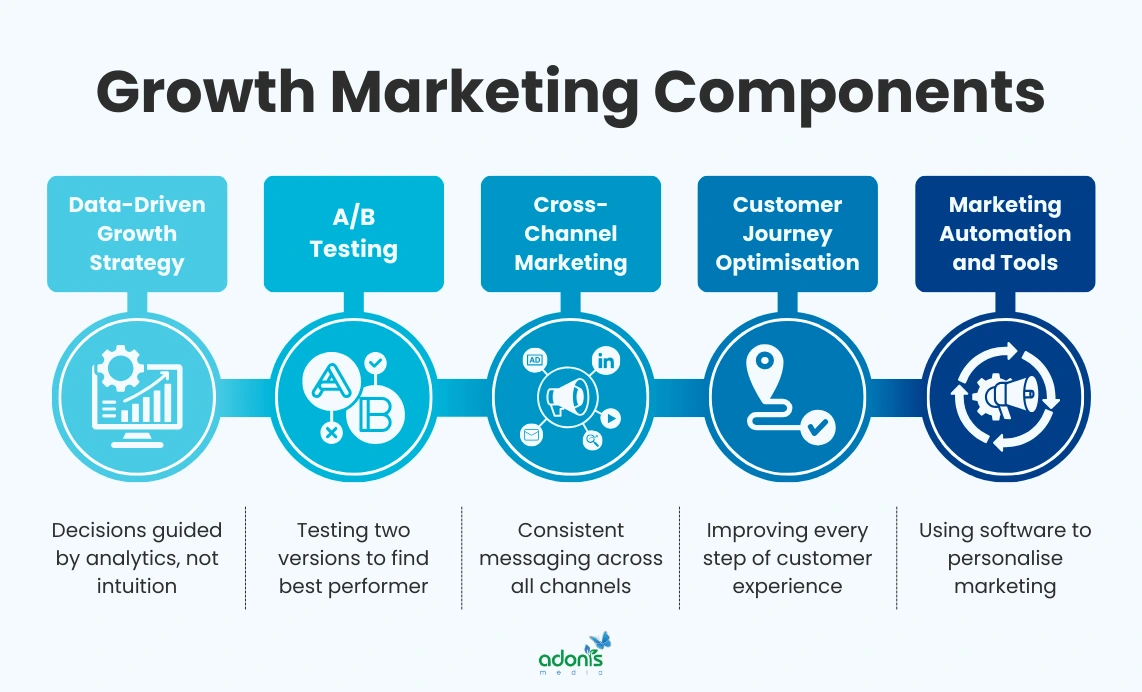
- Core components include data-driven strategy, A/B testing, cross-channel marketing, customer journey optimisation, and marketing automation and tools.
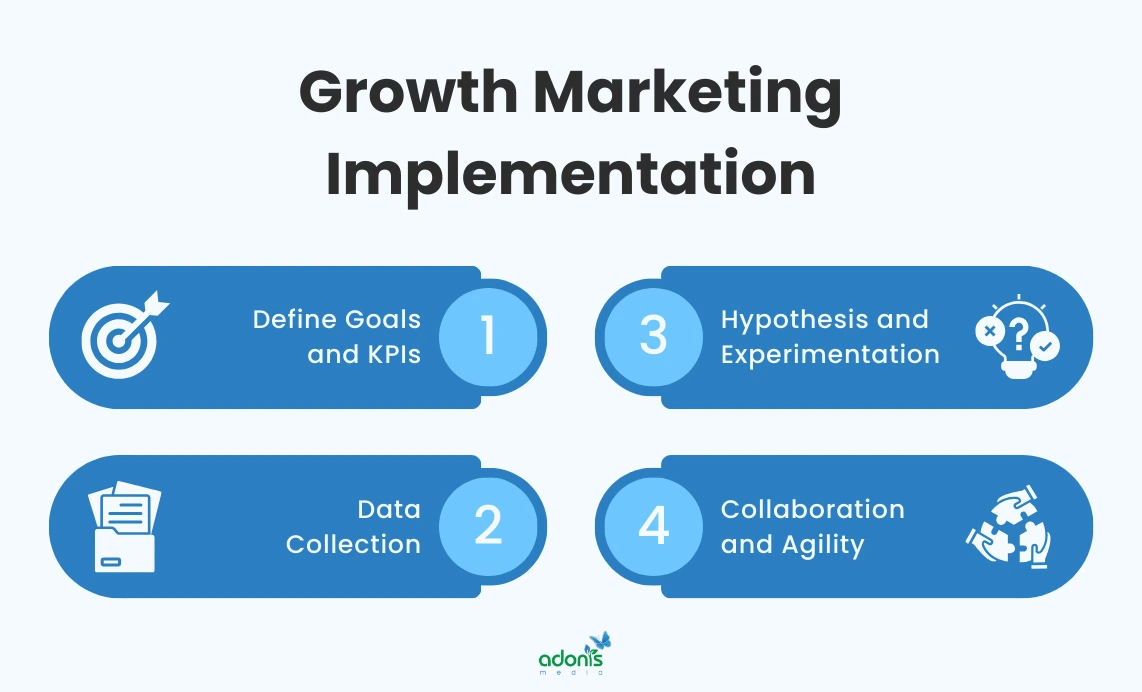
- Implementation steps include defining goals and KPIs, collecting data, experimentation and hypothesis testing, and collaboration and agility.
- Key metrics like CAC, CLV, and churn rates are essential for tracking growth marketing success.
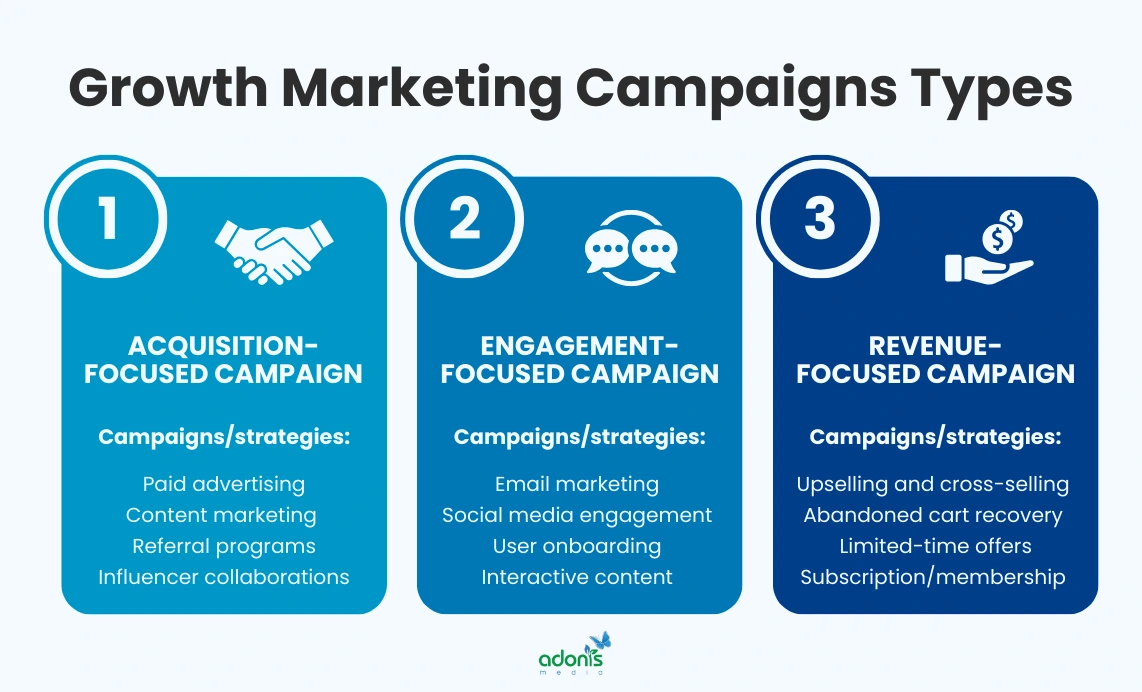
- Growth marketing campaigns can target acquisition, engagement, or revenue, with each using specific strategies for different business goals.
What Is Growth Marketing?
Marketing has shifted from traditional outbound methods to digital strategies, focusing on customer engagement and data-driven decisions. As businesses face global competition and changing consumer behaviour, growth marketing emerged as a strategic approach to sustainable business expansion.
Growth marketing is a data-driven methodology that focuses on the entire customer journey, combining experimentation, analytics, and continuous optimisation to drive sustainable business growth and customer retention.
What sets growth marketing apart is its emphasis on testing and measuring results across all marketing channels. Unlike traditional marketing, it goes beyond acquisition to include activation, retention, and revenue generation through systematic experimentation.
As we transform digitally, growth marketing is becoming more essential. It allows businesses to make informed decisions based on real data, reduce customer acquisition costs, and build lasting customer relationships through personalised experiences.
You may consider this just another inbound strategy akin to inbound marketing, but it goes beyond that.
While inbound marketing builds foundations through content and SEO, growth marketing adds rapid experimentation and data analysis. Both strategies share customer-centric approaches and rely on measuring results, though their execution differs.
Through continuous testing and refinement, growth marketing helps businesses achieve sustainable expansion by identifying what truly works. This iterative approach ensures that marketing efforts consistently improve, leading to better ROI and stronger customer relationships over time.
Growth Marketing vs Traditional Marketing: What's the Difference?
Understanding the distinctions between growth and traditional marketing helps businesses make informed decisions about their marketing strategy. It's very obvious based on the defintion of growth marketing, but let's still examine thoroughly how these approaches differ in their core aspects.
Marketing Goals and Objectives
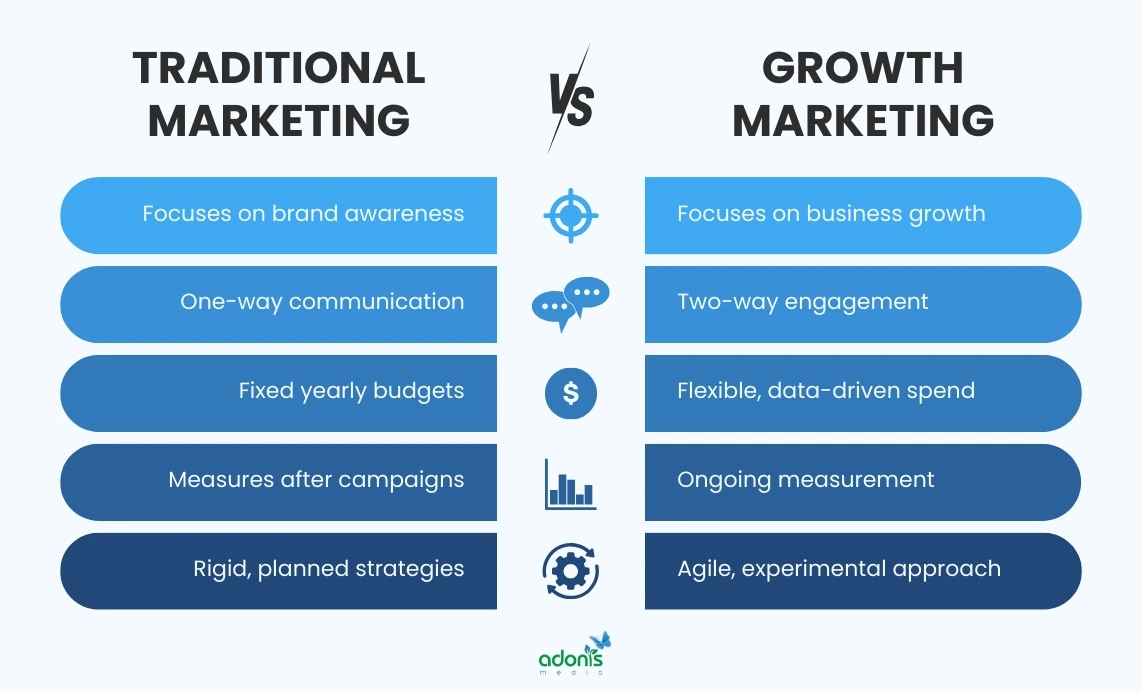
Traditional marketing primarily centres on brand awareness and reaching broad audiences through established channels like television, print media, and radio. The focus remains on creating memorable campaigns and measuring success through metrics like reach, impressions, and general brand recognition.
Growth marketing, however, aims to create sustainable, long-term growth through data-backed decisions and customer-centric strategies. This approach focuses on the entire customer journey, from acquisition to retention, using metrics directly tied to revenue and customer lifetime value.
The key difference lies in their end goals. While traditional marketing pursues brand visibility and awareness, growth marketing seeks measurable business growth through continuous experimentation and customer engagement throughout their journey.
Methodology and Approach
Traditional marketing follows a linear, campaign-based approach with predetermined strategies and fixed timelines. Teams often work in silos, creating content and campaigns based on creative intuition and established marketing principles rather than real-time data.
Growth marketing adopts an agile, experimental methodology that constantly tests and refines strategies. Teams use A/B testing, analytics, and customer feedback to make quick adjustments, employing cross-channel tactics while measuring the impact of each marketing effort.
The distinction lies in flexibility and data usage. Traditional marketing maintains rigid, predetermined plans, while growth marketing embraces rapid experimentation and adapts strategies based on performance metrics and customer behaviour.
Budget Allocation and ROI
Traditional marketing typically requires substantial upfront investments in media buying, production, and advertising space. These budgets are often allocated annually or quarterly, with limited flexibility to adjust spending based on performance during campaign periods.
Growth marketing takes a more fluid approach to budget allocation, distributing resources based on real-time performance data. Teams can quickly shift investments towards high-performing channels and experiments, scaling successful initiatives while cutting underperforming ones to maximise ROI.
Timeline and Results
Traditional marketing operates on fixed campaign schedules, often spanning months or quarters, with results typically measured after campaign completion. These campaigns require extensive planning and provide limited opportunities for mid-campaign adjustments or optimisation.
Growth marketing delivers faster, measurable results through continuous testing and optimisation. Teams can see the impact of their efforts in real-time, allowing for quick pivots and improvements while maintaining a steady flow of experiments to drive consistent growth.
How to Implement Growth Marketing
Implementing growth marketing requires a systematic and strategic approach. Here's a breakdown of the key steps.
1. Define Goals and KPIs
Setting clear objectives is the foundation of any successful growth marketing strategy. Without well-defined goals, measuring success becomes impossible.
A robust growth marketing strategy aligns business objectives with specific, measurable outcomes. This approach helps teams focus their efforts on activities that directly contribute to business growth while maintaining accountability through data-driven metrics.
Clear goals and KPIs enable teams to track progress effectively and make informed decisions about resource allocation and strategy adjustments.
Sample growth marketing goals you may use:
- Increase customer acquisition rate
- Improve customer retention and loyalty
- Boost customer lifetime value
- Enhance conversion rates across channels
- Expand market share in specific segments
Essential KPIs for growth marketing you can consider:
- Customer Acquisition Cost (CAC)
- Customer Lifetime Value (CLV)
- Monthly Recurring Revenue (MRR)
- User Activation Rate
- Customer Churn Rate
- Net Promoter Score (NPS)
2. Data Collection
Data collection involves gathering valuable customer information, market trends, and campaign performance through various channels.
Teams use tools like analytics platforms, surveys, customer feedback, and behavioural tracking to build a comprehensive understanding of their target audience.
Proper data collection helps teams make informed decisions about marketing strategies and resource allocation while identifying opportunities for growth and improvement.
The process typically involves using multiple methods such as website analytics, customer surveys, social media monitoring, and CRM systems to gather both quantitative and qualitative data.
3. Hypothesis & Experimentation
Growth marketing relies on forming educated guesses about what might improve performance and testing these by controlled experiments.
Teams develop hypotheses based on collected data and market insights and design experiments to validate or disprove their assumptions.
This systematic approach to testing helps teams avoid costly mistakes and ensures marketing decisions are based on actual results rather than assumptions.
Key elements of effective experimentation:
- Clear hypothesis statements
- Controlled testing environments
- Measurable success metrics
- Defined timeframes
- Documentation of results
4. Collaboration & Agility
Growth marketing thrives on cross-functional teamwork, where marketing, product, sales, and customer service teams work together to implement and refine strategies. This ensures that insights and opportunities are shared across departments, leading to more effective growth initiatives.
The advantages of collaborative growth marketing include faster problem-solving, more innovative solutions, and better resource utilisation. When working in sync, teams can respond quickly to market changes and customer needs.
Successful collaboration practices include regular cross-team meetings, shared project management tools, transparent communication channels, and joint goal-setting sessions. These practices help maintain alignment and ensure everyone works towards common objectives.
By fostering collaboration and agility, businesses can create a more responsive and effective growth marketing engine that consistently delivers results through shared knowledge and coordinated efforts.
Core Components of a Growth Marketing Strategy
A successful growth marketing strategy leverages a combination of methodologies, tactics, and approaches to drive significant business growth. Consider these core components listed below.
Data-Driven Growth Strategy
A data-driven growth strategy uses concrete information and analytics to guide marketing decisions rather than relying on gut feelings or assumptions. This ensures every marketing move is backed by solid evidence.
This component forms the foundation of growth marketing by enabling teams to make informed decisions, predict outcomes more accurately, and allocate resources more effectively based on real performance data.
A/B Testing
A/B testing systematically compares two versions of a marketing element, such as emails, web pages, or ads, to determine which performs better with your target audience.
This testing method is vital in growth marketing as it removes guesswork and provides concrete data about what resonates with customers.
Cross-Channel Marketing
Cross-channel marketing involves creating a consistent and seamless experience across multiple marketing channels, from social media and email to paid advertising and content marketing.
This is essential in growth marketing because it helps reach customers wherever they are, creating multiple touchpoints that work together to drive engagement and conversions.
Customer Journey Optimisation
Customer journey optimisation involves analysing and improving each interaction a customer has with your brand, from initial awareness through to post-purchase engagement and loyalty.
This component is crucial as it helps identify friction points and opportunities to enhance the customer experience.
Teams can optimise the customer journey by mapping touchpoints, collecting feedback, analysing behavioural data, and continuously improving based on customer interactions.
Marketing Automation and Tools
Marketing automation involves using software and tools to streamline repetitive marketing tasks, manage campaigns, and deliver personalised customer experiences at scale.
Popular marketing automation tools include HubSpot for comprehensive marketing management, Mailchimp for email automation, Google Analytics for data tracking, Hotjar for user behaviour analysis, and SEMrush or Ahrefs for SEO and content optimisation.
Types of Growth Marketing Campaigns
Growth marketing campaigns come in various flavours, each tailored to achieve specific business objectives. These campaigns leverage data, experimentation, and creative strategies to drive growth in different aspects of a business.
Here, we delve into three prominent types of growth marketing campaigns.
1. Acquisition-Focused Growth Marketing Campaign
Acquisition-focused campaigns emerge as the driving force behind expanding customer bases and propelling businesses to new heights.
These campaigns are meticulously designed to attract, engage, and convert potential customers, acting as the initial touchpoint that introduces brands to their target audiences.
Strategies include:
- Paid Advertising Campaigns: Leveraging platforms like Google Ads, Facebook Ads, and other social media ads to target specific demographics and capture the attention of potential customers.
- Content Marketing Campaigns: Creating valuable and relevant content to attract organic traffic, engage visitors, and nurture them into leads.
- Referral Programs: Encouraging existing customers to refer friends and family in exchange for rewards, effectively utilising word-of-mouth marketing.
- Influencer Collaborations: Partnering with influencers in your industry to tap into their established audiences and gain exposure to new potential customers.
2. Engagement-Focused Growth Marketing Campaign
Engagement-focused campaigns emerge as the architects of lasting relationships between brands and their customers.
These campaigns are crafted to foster interactions, cultivate loyalty, and enhance customer satisfaction. By placing emphasis on genuine connections and meaningful interactions, engagement-focused growth marketing campaigns are at the forefront of building brand communities.
Strategies include:
- Email Marketing Campaigns: Sending targeted and personalised emails to nurture leads, deliver valuable content, and promote special offers.
- Social Media Engagement Campaigns: Encouraging interactions, discussions, and user-generated content on social media platforms to foster community engagement.
- User Onboarding Optimisation: Ensuring a seamless and enjoyable onboarding process for new users to maximise retention and usage rates.
- Interactive Content Campaigns: Creating quizzes, polls, contests, and other interactive content that engages users and encourages them to participate.
3. Revenue-Focused Growth Marketing Campaign
Revenue-focused campaigns take centre stage as the architects of increased profitability and financial success.
These campaigns are crafted to optimise the customer journey, drive sales, and enhance customer lifetime value. By strategically honing in on revenue generation, businesses can propel their growth trajectory to new heights
Strategies include:
- Upselling and Cross-Selling Campaigns: Recommending complementary products or upgrades to customers during their buying journey to increase the average transaction value.
- Abandoned Cart Recovery Campaigns: Sending targeted reminders to customers who abandoned their shopping carts to encourage them to complete their purchases.
- Flash Sales and Limited-Time Offers: Creating a sense of urgency with time-limited promotions to stimulate immediate purchases.
- Subscription and Membership Campaigns: Offering subscription models or exclusive memberships with added value to secure recurring revenue.
Further Learning
Looking to learn more? I've collected some fantastic resources that go hand-in-hand with this topic if you want to dive deeper.
-
growth-os.com — A/B Testing for Growth Marketing; a guide to experimentation
- hbr.org — Analytics for Marketers
- hubspot.com — How to Create a Cross-Channel Marketing Campaign [+Benefits & Examples]
- zapier.com — The best marketing automation software
- reddit.com — Reddit r/marketing Thread: "What does a growth marketer do?"
- quora.com — Quora Discussion: "What does data and analytics in marketing mean?"
- quora.com — Quora Discussion: "What are some suggestions for growth marketing?"
- quora.com — Quora Discussion: "How do you explain growth hacking concepts to non-marketing gal?"
Scale Your Success with Growth Marketing
Growth marketing is a powerful approach combining data-driven decisions, continuous experimentation, and customer-focused strategies. Moving beyond traditional marketing methods enables businesses to achieve sustainable growth through measurable results and adaptable tactics.
The combination of strategic goal-setting, thorough data collection, systematic testing, and cross-channel optimisation creates a robust framework for success in today's digital landscape.
Ready to transform your marketing strategy and drive real business growth? Our team of experienced marketing specialists can help you develop a tailored approach that delivers measurable results. Book your free consultation today, and let's craft your success story together!
Got a question in mind? Check out the FAQs below for quick answers!
